
Excessive Hair Breakage: Improve Handling and Heat Protection
Excessive hair breakage happens when strands snap somewhere along their length rather than naturally shedding from the root. Frequent heat, chemical processing, tight hairstyles, rough detangling, and dryness can all make hair easier to break. Improving daily handling often matters as much as buying a new treatment.
Breakage Is Different From Normal Shedding
Naturally shed hairs usually leave the follicle after completing their growth cycle. Breakage produces shorter pieces because the hair shaft fractures before the whole strand is released.
Looking at the pattern can help. Numerous short hairs, uneven ends, and snapping during brushing suggest breakage, while an increase in full-length hairs coming from the root may point toward shedding that deserves separate evaluation.
Handle Fragile Hair With Less Force
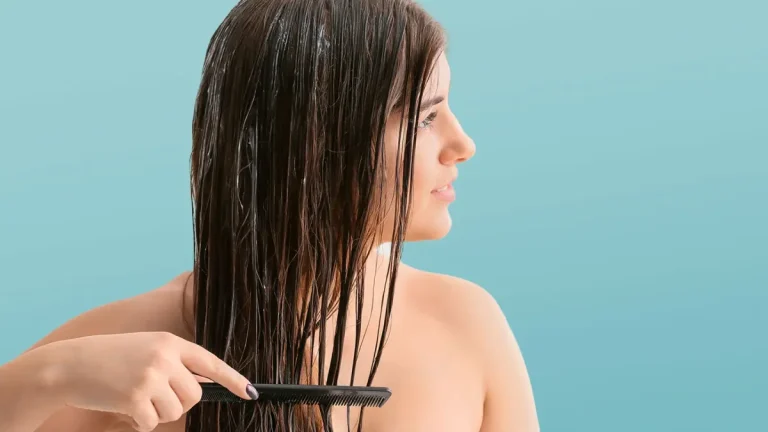
Start by reducing the amount of pulling involved in everyday grooming. Work through tangles in small sections, beginning at the ends, and use enough conditioner or detangling product to create slip.
Broader body-care reading can introduce many possible explanations for hair changes, but the simplest question is often how much mechanical stress the hair receives each day. Rough brushing, tight elastics, extensions, and repeated manipulation can accumulate.
The American Academy of Dermatology also advises gentle handling, conditioning, and limiting damaging hair practices when strands are fragile. American Academy of Dermatology healthy-hair tips
Use Heat More Strategically
Heat damage is strongly influenced by temperature, exposure time, and frequency. Straightening the same section repeatedly at a high setting creates more stress than an occasional lower-temperature styling session.
Some general protection guidance emphasizes avoiding hazards entirely, but hair care often benefits from moderation rather than all-or-nothing rules. Partially air-drying, using lower settings, and spacing out styling sessions can reduce cumulative damage.
| Source of Stress | What You May Notice | Practical Change |
|---|---|---|
| Repeated heat | Dry, snapping strands | Reduce temperature |
| Tight hairstyles | Breakage near tension points | Wear looser styles |
| Rough detangling | Short broken pieces | Work from ends upward |
| Chemical processing | Increased fragility | Increase time between services |
Support Hair Between Styling Sessions
A moisturizing conditioner can reduce friction between strands, while a leave-in conditioner or detangler may make combing easier. Products are most helpful when they reduce manipulation rather than simply coating hair with a heavy residue.
People exploring everyday vitality topics may also see nutrition discussed in relation to hair. Diet can matter to overall hair health, but visible breakage caused by hot tools or rough styling still requires changing those habits. Supplements won’t protect a strand from repeated physical damage.
Where Hair-Breakage Advice Can Go Wrong
Treating every broken strand as evidence of a vitamin deficiency is a common mistake. Hair can become fragile for ordinary mechanical reasons, and taking unnecessary supplements doesn’t remove heat or tension.
The opposite assumption is also risky. If hair suddenly becomes much more fragile without a clear styling change, or if breakage appears alongside thinning, scalp symptoms, fatigue, or other unexplained changes, it makes sense to investigate rather than simply adding stronger hair products.
When to Get Professional Help
Consider seeing a dermatologist if breakage is severe, appears suddenly, or occurs together with bald patches, significant shedding, scalp inflammation, pain, scaling, or changes in the nails or skin. A clinician can distinguish shaft breakage from hair loss occurring at the follicle.
Prompt assessment is also sensible when hair keeps worsening despite stopping obvious sources of damage.
Frequently Asked Questions
Can heat protectant completely prevent hair breakage?
No. A heat-protection product may reduce some thermal damage, but it cannot make frequent high-temperature styling harmless. Temperature, frequency, technique, and the hair’s existing condition still matter.
Why does my hair break more after bleaching?
Bleaching chemically alters the hair shaft and can weaken its structure. Heavily processed strands therefore tend to tolerate brushing, heat, and additional chemical treatments less well.
How can I tell breakage from new hair growth?
New growth often has tapered natural ends and appears in patterns consistent with growing hair. Broken pieces may have blunt, frayed, or irregular ends and can appear at many different lengths.
Reduce the Stress Before Adding More Products
Hair that snaps easily needs protection from repeated stress. Handle it gently, condition consistently, loosen high-tension styles, and make heat an occasional tool rather than an automatic daily step.
If the pattern is severe, sudden, or accompanied by true hair loss or scalp symptoms, professional assessment can help identify what routine changes alone cannot explain.
This article is for general informational purposes and is not a substitute for professional medical advice, diagnosis, or treatment.